

by
ERIC COMPTON
For some members, a swimming pool is one of the most enjoyable features of the home. It provides a place to relax, exercise, and spend time together, especially during the hot Texas summer.
But, while pools offer comfort and recreation, they also require a surprising amount of electricity to operate. For some members, pool equipment can become one of the largest contributors to summer electric use and, in some cases, winter use as well.
It is important for pool owners to understand how pools consume energy, which equipment uses the most electricity, and what steps can be taken to reduce usage without sacrificing water quality or equipment protection. From the main circulation pump to cleaner pumps and freeze protection settings, every part of a pool system can affect overall energy consumption.
One of the biggest factors affecting pool energy use is how long the circulation system runs each day. That runtime can vary depending on several conditions, including:
- Temperature
- Pump size
- Pool size
- Type of pump
- Condition of the water
When members think about the cost of owning a pool, they generally consider chemicals, maintenance and maybe a few float toys for the kids. But one of the biggest ongoing costs often comes from something working quietly behind the scenes: the pool pump.
The main circulation pump is the heart of the pool system. It keeps water moving through the filter, helps remove debris and circulates chemicals to keep the water clean and safe. Because it often runs every day during the summer, it can also be one of the largest energy users in the home.
Most residential in-ground pools use a pump in the one to two horsepower range. Larger pools or more elaborate systems may have a 3-horsepower (HP) pump. In simple terms, the bigger the pump and the longer it runs, the more electricity it uses.
As a general estimate, a 1-HP pump may use about 1,000 watts while running. A 2-HP pump may use around 2,000 watts and a 3-HP pump may use roughly 3,000 watts. That can add up quickly over time. For example, a 2-HP pump running eight hours a day could use up to 16 kilowatt-hours (kWh) per day, or 480 kWh each month.
Some pools also have a cleaner pump, sometimes called a booster pump, which powers certain automatic pool cleaners. While these pumps are usually smaller than the main circulation pump, they still add to the monthly electric bill. A typical cleaner pump may use 800 to 1,200 watts, which could add another 48 to 72 kWh per month if it runs for two hours a day.
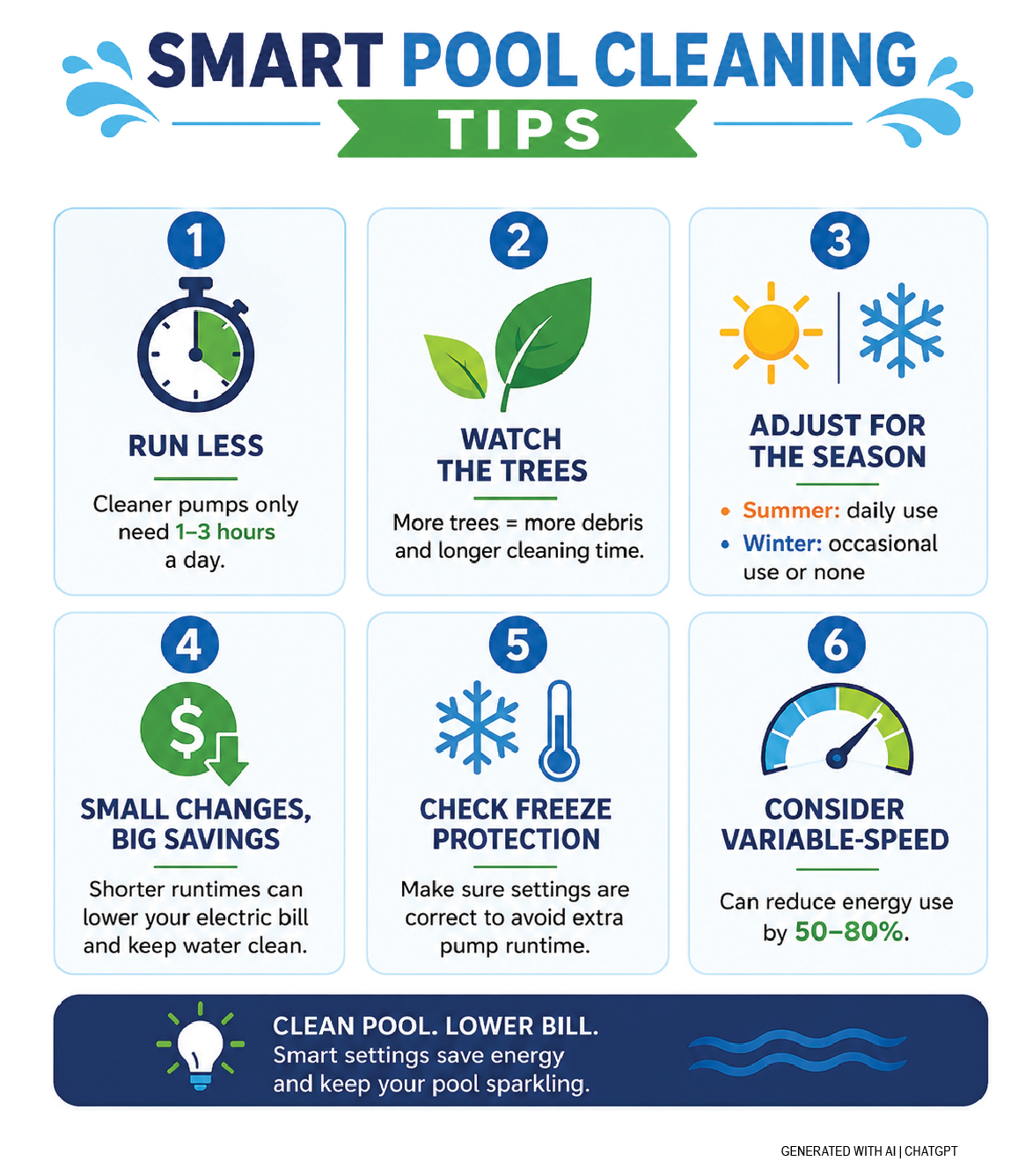
The good news is that cleaner pumps usually don’t need to run all day. In many cases, one to three hours a day is enough, depending on the amount of debris, weather conditions and nearby trees or landscaping. A few small adjustments to pump run times can go a long way toward keeping the pool clean and keeping energy use in check.
Seasonal changes also play an important role in pool energy use. During the summer months, pools usually require more circulation because of higher temperatures, heavier use, stronger sunlight and greater chemical demand. United’s Energy Solutions Team recommends the main circulation pump to run about eight to 10 hours per day, or one hour per every 10 degrees it is outside in the summer to maintain proper water quality. If the pool includes a cleaner pump, that equipment may run an additional one to three hours per day as needed.
During the winter months, many pools run less because water temperatures are lower, algae growth slows and the pool may see little to no use. In these conditions, the main pump may only need to run about four to six hours per day, and the cleaner pump may only need occasional use or may not be needed at all. Adjusting pump schedules to match the season is one of the simplest ways for pool owners to improve efficiency and avoid unnecessary electric use.
Another factor that affects winter energy use is the freeze protection. Many pool systems are equipped with an automatic freeze-protection feature designed to protect plumbing and equipment when temperatures approach freezing. When activated, the system automatically turns on the pool pump to keep water circulating through the pipes, filter and heater. Because moving water is less likely to freeze, this feature helps prevent costly damage to pool equipment and plumbing.
Freeze protection is an important safeguard, especially during cold snaps, but it can also increase electricity use. In some cases, a pump may run for much of the night or for many additional hours over several days when temperatures remain near or below freezing. Members may notice a higher-than-normal electric bill during these periods, particularly if the pump is a single-speed model that runs at full power whenever it is on. While freeze protection is necessary when conditions require it, it is still wise to make sure temperature settings are correct and equipment is operating as intended.
One of the most effective ways to reduce pool energy use is to install a variable-speed pool pump. Traditional single-speed pumps operate at one speed only: full power. That means they use the same amount of electricity whether the pool needs a high flow rate or not. Variable-speed pumps can operate at lower speeds for longer periods of time, providing the needed circulation while using far less energy.
This matters because pump energy use does not decrease in a simple one-to-one way with motor speed. When pump speed is reduced, the power required drops dramatically. As a result, a variable-speed pump can often reduce electric consumption by 50 to 80 percent, depending on how it is programmed and how it replaces an existing system. In addition to lowering energy use, variable-speed pumps are often quieter, improve filtration by circulating water more steadily and may help extend the life of pool equipment by reducing wear and tear.
If considering an upgrade, the savings can be substantial. A single-speed pump using several hundred kWh each month may be replaced with a variable-speed model that uses only a fraction of that amount under normal operation. Over time, the reduced energy cost can help offset the purchase price of the pump, especially in homes where the pool operates for much of the year.
The bottom line is this: pools are meant to be enjoyed, not to drive up your electric bill. By paying attention to how long your equipment runs, making seasonal adjustments and investing in efficient technology, you can take control of your energy use.
A little awareness goes a long way. With the right approach, you can keep your pool comfortable and cost-effective, all summer long without making a splash on your electric bill.
For members interested in learning more, United Cooperative Services offers a free in home energy audit. It’s a simple way to discover additional opportunities to save and make the most of your home’s energy use. Reach out to any United office, or visit us here, to request a visit with one of our Energy Solutions Specialists regarding your energy use.
Read past issues