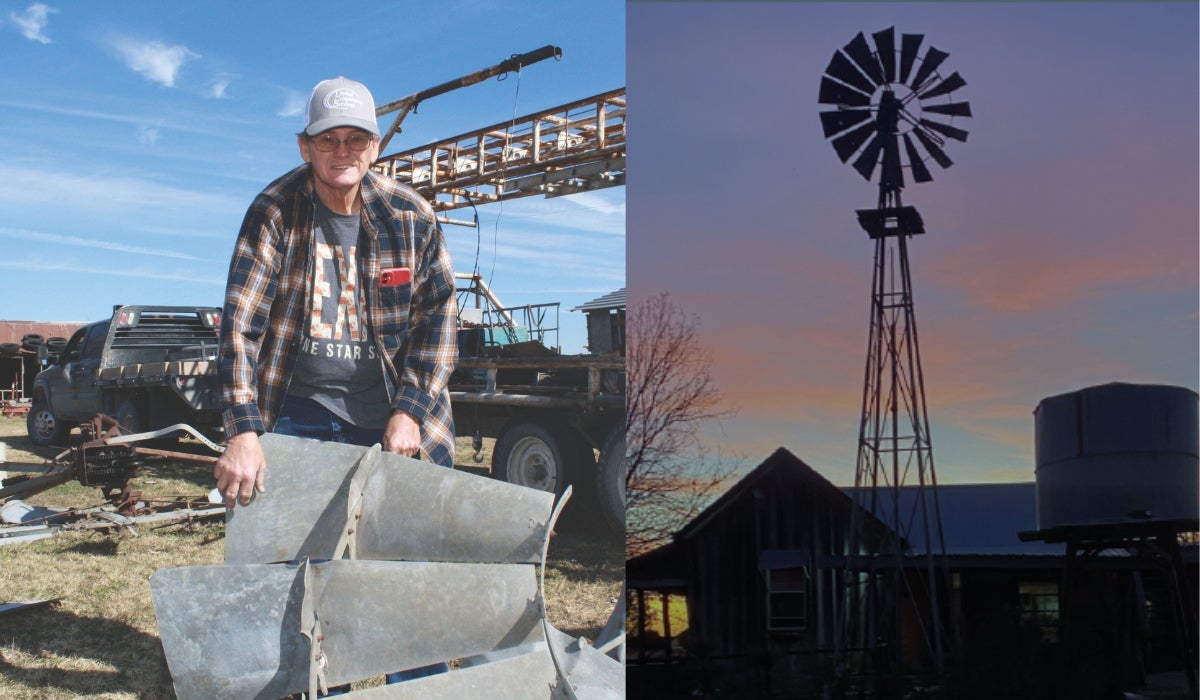

In a world of high-tech, disposable items, one United member
is preserving America’s rural past by restoring antique windmills,
keeping them spinning for generations to come.
by
JOHN DAVIS
A cow moos somewhere in the distance as Alan McLearen walks toward his windmill trailer that’s parked behind his house in De Leon.
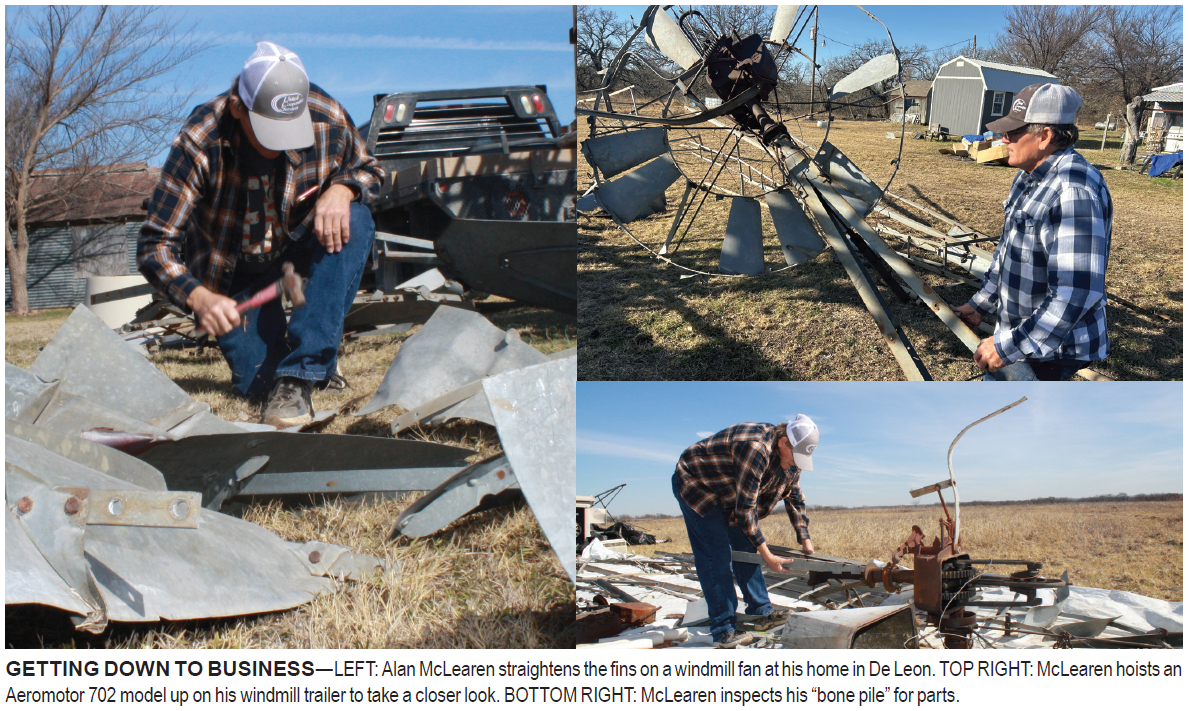
Beside it, the hulk of an Aeromotor windmill head—a popular 702 model probably made in the 1920s—lays rusted, face-down and forlorn on its 8-foot fan. He uses the trailer’s electric winch to lift all 400 pounds of it off the ground to take a better look.
The guide wheel is broken, he points out. The majority of the fan’s fins need replaced. Its vane lists “Prewitt Hardware, Taylor, Texas” in faded black paint as the original point-of-sale probably more than 100 years ago.
Nearby, another windmill lays with its fan in slightly better condition, but its tail is missing. He looked high and low for it during the salvage effort, he says, but the vane couldn’t be located. It was gone with the wind, in a manner of speaking, possibly ripped away long ago by a small tornado.
He’ll grind the rivets off broken fan blades and replace or repair them. Even if they’re bent into horrific shapes from high winds and neglect, he’s discovered that the sandy soil of what was once his grandfather’s peanut patch makes the perfect place to hammer them back into shape.
McLearen is a United member with a passion for these antique machines. To the untrained eye, what’s left of the windmill heads—once a common, steadfast sentinel across the rural American landscape—may appear like scrap and too damaged to repair. But McLearen assures there’s plenty of life left. When he’s done, they’ll be almost as good as new. The original design and craftsmanship of the windmills, paired with his confidence in his repairs, allows him to guarantee his work.
It will take about a day for him to complete, he says.
“Not everything is perfect when I’m done, but I guarantee everything that I do,” he says. “I keep working on them until they’re right.”
His customers like imperfection and want the character and patina from a life on the range. They don’t mind dents or dings. The older, the more authentic, the better.
“Nobody really wants a new one,” he says.
Discovering the Drive to Revive
A self-proclaimed tinkerer, McLearen says his love for windmills began several years ago when he wanted to make repairs and stand up two on his land, including one his grandfather had worked on years ago.
He says he contacted a local windmiller named Cliff Conway to learn more about what it might take to repair them. Conway was an established windmill legend, having repaired windmills in the area since 1983. The pair had several conversations that intrigued McLearen about how they were made and how to repair them.
When Conway suddenly passed away in 2023, McLearen learned of his passing after he met Conway’s son, Nolan, at Cliff’s windmill repair shop in nearby Comanche, Texas.
Nolan describes his father as a windmiller through-and-through. When making a living growing peanuts became impossible in the early ’80s, Cliff swapped careers the year Nolan was born, hand-built the specialized trailer in 1984 and never looked back.
“He was a windmill guy, 200 percent,” Nolan says. “He lived it. He loved it. He absolutely loved windmills, and I know this because I was up there chained off with him since I was big enough to get up a windmill. He never hated a day at work.”
“Not long after dad passed away, I was over there working at dad's shop,” Nolan recalls. “Alan stopped by and told me that he'd been talking to Dad about, you know, windmill parts and working on them and all that kind of stuff. He said, ‘I want to get into it more. I'm intrigued by it. I love doing it.’ And I said, ‘Dude, if I can help you in any way, I will definitely help you.’”
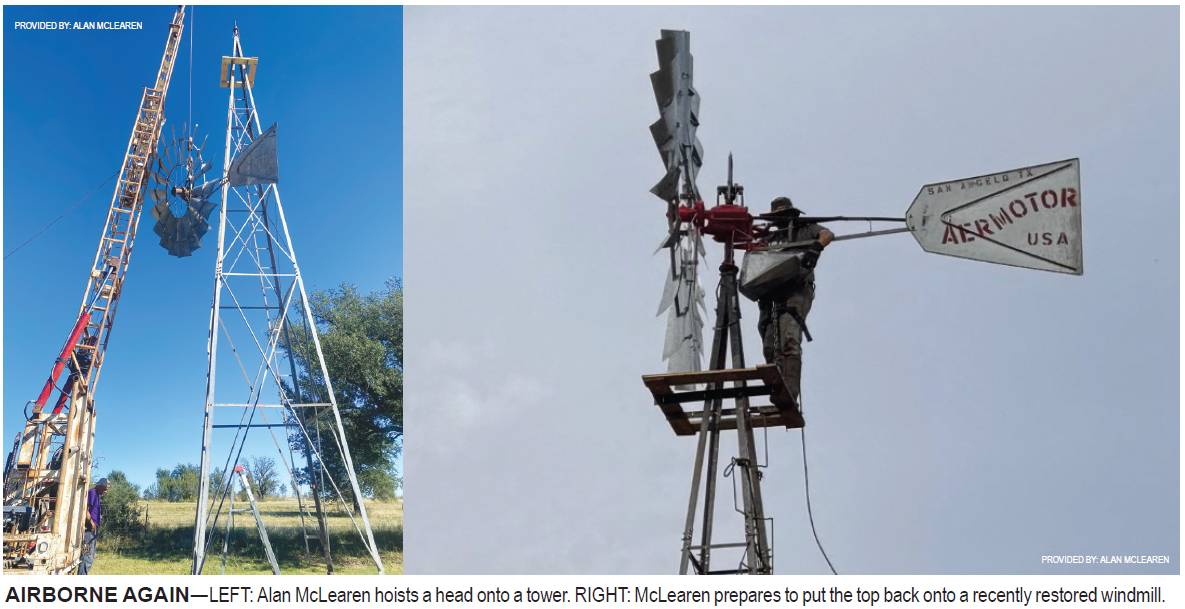
Nolan needed help standing up a windmill in San Angelo that his father had repaired before his passing and McLearen was more than willing to help and learn on the job. McLearen also learned Nolan was interested in selling the windmill trailer.
“It was absolutely hard to see it go, but that was the deal I made with Alan,” Nolan says. “I said, ‘I'm not going to just let it go to somebody that's going to use it for a winch.’ I mean, he built it. He basically designed it off of a drilling rig. That’s where the design came from. I told Alan, I said, ‘As long as it's getting used for what Dad built this for, I'm happy seeing it go to somebody. And that's why I told Alan, ‘I'm gonna make you a hell of a deal on this thing.’”
Before McLearen knew it, he says he was in the windmill business receiving referrals from Conway’s client list and others as word spread.
“It has made my heart happy just seeing that trailer used,” Nolan says. “Alan sends me pictures all the time and videos where he's out there using it. And I'm like, ‘Dude, Dad would be so proud. I mean, I'm proud, but Dad would be super proud that it's not just sitting.’”
Business is Blowing Up
Since that time, McLearen has taught himself the disappearing trade of repairing windmills, asking questions from others in the business, and learning the ins and outs of different brands and models through hands-on experience, trial-and-error and YouTube.
“I like to take something that’s 100 years old, put it back together again. I am satisfied by doing that. There’s satisfaction knowing I took something that was discarded—thrown away—and made it work again. I can drive by and say, ‘Look, I did this one, and I did that one over there.’ They’ll still be there after I’m gone.”
For six days a week, he drives a truck for Reynolds Nationwide in Stephenville delivering dairy milk to Houston and San Antonio. He uses his two days off for windmill repair.
It may seem counter-intuitive to begin a windmill business in a world where windmills are quickly disappearing, he admits. Mechanical windmills, whether vintage or new, require regular maintenance, specialized equipment for some repairs and sometimes a dangerous climb up tall towers. Because of this, many farmers and ranchers have replaced the old-fashioned windmills with less expensive solar pumps that are a third of the cost, sit at ground level and are easier to service.
Despite the ease and affordability of modern technology, many aren’t interested in swapping out, McLearen says, and his phone regularly rings with requests for his service by customers interested in preserving a piece of the past.
Some clients want a fully functional windmill that will pump water, he says, while others want a decorative windmill and tower either for their business or for nostalgia’s sake. Either way, he’s at the ready with a field of carefully stacked parts and pieces ready to once again achieve functionality with McLearen’s careful coaxing.
In nearly two years since he started, he’s repaired 18 and has nine on his to-do list. His customers are willing to pay as much for a revived relic as they would a brand-new windmill. One of his authentic, restored windmills may cost the new owner about $3,500 to $4,500 for the finished product and his service to place it on their property.
Scott Williams is owner of WWC Enterprises and Texas Sage Nursery in Dublin. A long-time friend of Cliff Conway, he bought the leftover windmill parts from Cliff’s business and met McLearan through Nolan Conway.
After Cliff died, Williams says he was glad that McLearen had the interest to continue the work. Now that he is the local windmiller, Williams supplies him with parts and pieces he may need to make repairs.
“The windmills are a unique deal, because there’s only a handful of people that understand how they work and how to fix them,” he says. “That’s kind of why, whenever Cliff died, I thought, ‘Man, all his knowledge is gone, and that trade is dying so fast.’ Most of the well guys would just as soon drop a solar pump in the hole than anything. There’s still a slew of windmills out there that need their oil changed and need to be kept up with.”
Williams says he and McLearen have formed not only a friendship but also a helpful business relationship. If McLearen needs a part, he is always welcome to look through Williams’ inventory. He thinks it’s important to keep this part of America’s agricultural culture alive.
“You know, one of the reasons why we’re all here is because of the windmills,” he says. “Without water, we couldn’t have made it. You just couldn’t have gone west. If you wanted to really thrive and survive, you had to somehow get a windmill up to get the water out. It’s a piece of history.”