United CEO Shares the Playbook With Members
at the Cleburne Community Meeting
by
JOHN DAVIS
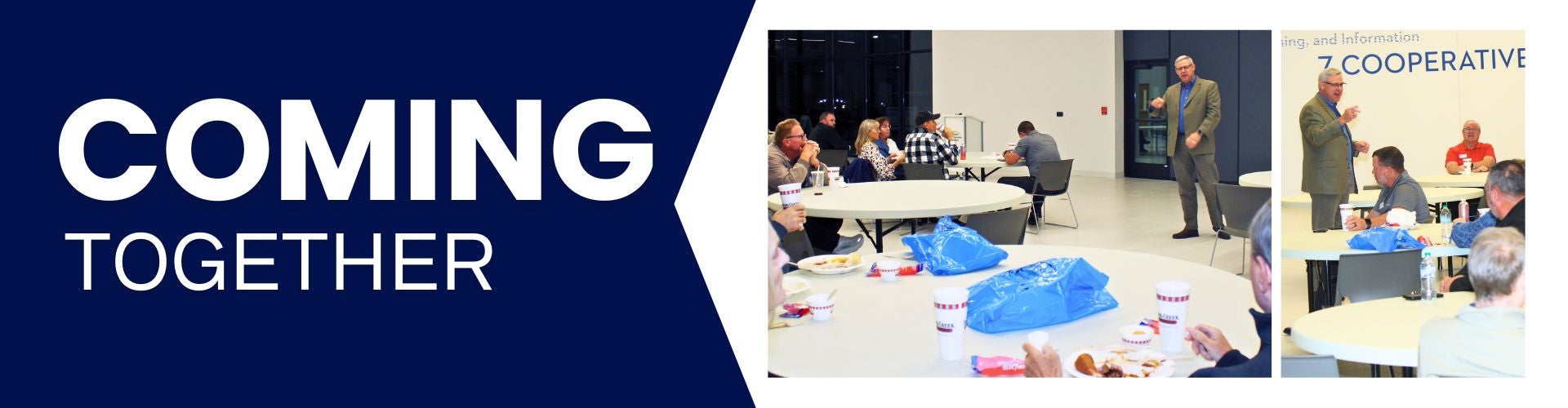
Chairs filled quickly inside the Community Room of United Cooperative Services’ newly reconstructed Cleburne Office as members gathered for the co-op’s final community meeting of the year on Nov. 10.
United CEO Cameron Smallwood encouraged attendees to steer the evening’s discussion by asking him whatever they wondered about their cooperative.
“I have something prepared, but I’d much rather talk about what y’all want to talk about,” Smallwood said. “This is your meeting, and I’ll answer any questions you may have as frankly as I can.”
During the event, which included a barbecue dinner, Smallwood covered a multitude of topics from electricity rates and the co-op’s effort to keep costs low for members to cybersecurity and the high-speed internet service.
He also explained how the cooperative model is alive and well, delved into the successes it enjoyed and the challenges it faces, and described how United plans to overcome those challenges.
The Meaning of Membership
From the start, the message centered on cooperation and the co-op difference. In contrast to for-profit utilities, the cooperative returns excess revenue—referred to as margins—to members in the form of checks or bill credits. These excess margins were returned to United members in October.
“Every one of you who’s a member of the co-op is also an owner of the electric cooperative,” Smallwood said. “If we make a million dollars at the end of the year, that money eventually comes back to you. We’re not incented to make big profits. Our goal is to make enough to run the business and satisfy our lenders. Anything beyond that gets allocated back to our members.”
While he acknowledged the co-op paused this program following Winter Storm Uri and the resulting bankruptcy of former power supplier, Brazos Electric Power Cooperative, he said annual member dividends have resumed.
This October, members who earned more than $20 received their dividend in the form of a check. Less than $20, and they received it as a credit on their energy bill.
“We’re glad to be able to once again provide member dividends,” he said.
Power Prices: Some Relief May be Coming
One of the night’s first questions was the one on nearly every member’s mind: Are rates going up?
Smallwood answered with cautious optimism.
About 70–80 percent of members’ electric bills come from wholesale power costs, he said. For the past several years, the co-op has enjoyed stable pricing through a favorable wholesale power agreement with Constellation Energy. But that contract expires soon.
The latest strategy—utilizing a partial long-term agreement with Constellation and selective market purchases—could actually lower power costs, he said.
“I don’t want to overpromise,” Smallwood said. “But based on what we’re seeing, we believe we can save money while managing the risk.”
The Annual Summer Game: Peak Alerts
Members asked about the increasingly frequent “peak alerts” announced during the cooperative’s Beat the Peak program—requests for members to reduce usage to help lower future transmission charges.
Beat the Peak is an early warning system that tells United members when energy prices peak, and how they can avoid paying peak prices for power.
Lower demand at peak time lowers the co-op’s overall cost for power, he said. As a nonprofit entity, United then passes the energy savings on to members. The more people who participate in this voluntary program, the more energy and energy dollars are conserved.
“We’ve been doing Beat the Peak for several years now,” Smallwood said. “Some summers are simple. This year wasn’t. Most of the time we predict three or four of the peak days. We do a pretty good job, which reflects as reduced costs in our transmission costs that following year over what it would have been had we not worked together to reduce. Any way we can save you money, we try to do it.”
He emphasized that these efforts save money for the entire membership the following year.
A Growing System, A Changing Workforce
The co-op now has 230 employees across 14 counties and seven offices, including 28 dedicated to internet services. Staffing is “stable,” Smallwood said, though retirements remain an ongoing challenge.
“We’ve replaced about 100 people in the past five years,” he said. “And we expect more retirements in the next seven.”
United ranks as one of the nation’s most efficient cooperatives based on meters per employee, he added.
“That’s good for you, because fewer employees per meter means lower cost,” he said.
87 Percent Without Becomes 87 Percent With
When members first approved the co-op’s entry into broadband in 2019, 87 percent of homes in United’s service area lacked access to high-speed internet. Today, more than 87 percent have it.
To date, United serves about 34,000 internet subscribers, and Smallwood credited the co-op’s high service ratings—among the top in the nation, he said—to local crews and fast response times tied to the cooperative’s mantra of exceptional service and value.
Several changes have impacted the cooperative’s long-term internet deployment plan, Smallwood said. Chief among them is the recent decision by the federal Broadband Equity Access and Deployment Program (BEAD) to pass on funding of United’s project, which aimed to connect roughly 5,000 members who weren’t served by United’s fiber network with access to high-speed internet. Instead, grant organizers awarded funding to other internet providers.
Texas is slated to receive only $1.3 billion in the latest round of BEAD funding compared to the $3.3 billion it received two years ago, according to a November article from The Texas Tribune.
Without the federal funds, it makes building to those members economically unfeasible, he said.
“So ultimately, the last section that we haven’t served, another provider is required to do that within the next two to three years” Smallwood said. “And so within three years from now, all of our members should have access to high-speed internet, much because of what we did.”
Competition in many areas has gotten fiercer, Smallwood said. For example, internet provider Spectrum has begun overbuilding much of United’s network in Johnson County in an attempt to woo United high-speed internet subscribers.
United typically chooses not to overbuild other providers because it isn’t a responsible use of the members’ money, he said.
“It’s crazy,” he said. “I bet you Spectrum will spend tens of millions over three years rebuilding what we’ve already built in hopes to basically steal a few of you from us. And they’re going to offer you unbelievable rates and offers to get you to switch. And guess what? The rates last for months, or maybe a year or two, and then they’re likely going to be higher than us, and you have to deal with their service.
“If you’re on our service and your line gets cut, we’re there that day or the next. If you’re with the other guys, it might be a week.”
To continue providing exceptional internet service, Smallwood said they are upgrading the system to ensure it’s ready for future growth.
“We’re not motivated by profit,” he said. “We’re motivated by being a co-op and providing a high-quality service. So, that’s what makes us different.”
Cybersecurity: Constant Pressure & Vigilance
One member asked about internet safety: “Is everything secure?”
“I’d love to tell you nothing will ever happen,” Smallwood replied, “but the crooks are good. Really good. And they never stop. What I can tell you is we’ve spent a significant amount of time, effort and resources to keep us secured, both electrically and on the internet. We have folks in our organization that do nothing but that, and we have outside contractors who test us to make sure we’re doing a good job. It’s something that we pay very close attention to.”
He said the co-op faces “millions of attacks” and employs dedicated staff and outside partners for continuous testing and monitoring. No major incidents have occurred, he added.
A Cooperative Defined By Members
As the meeting wrapped, Smallwood thanked the crowd for their engagement and questions—so many that he never touched his printed notes.
“This is your co-op,” he said. “We exist for you, and we make decisions with you in mind.”
Read past issues