United Linemen Brighten the Lives of
Several While Participating in Light Up Navajo
by
JOHN DAVIS
The big moment arrived by late afternoon.
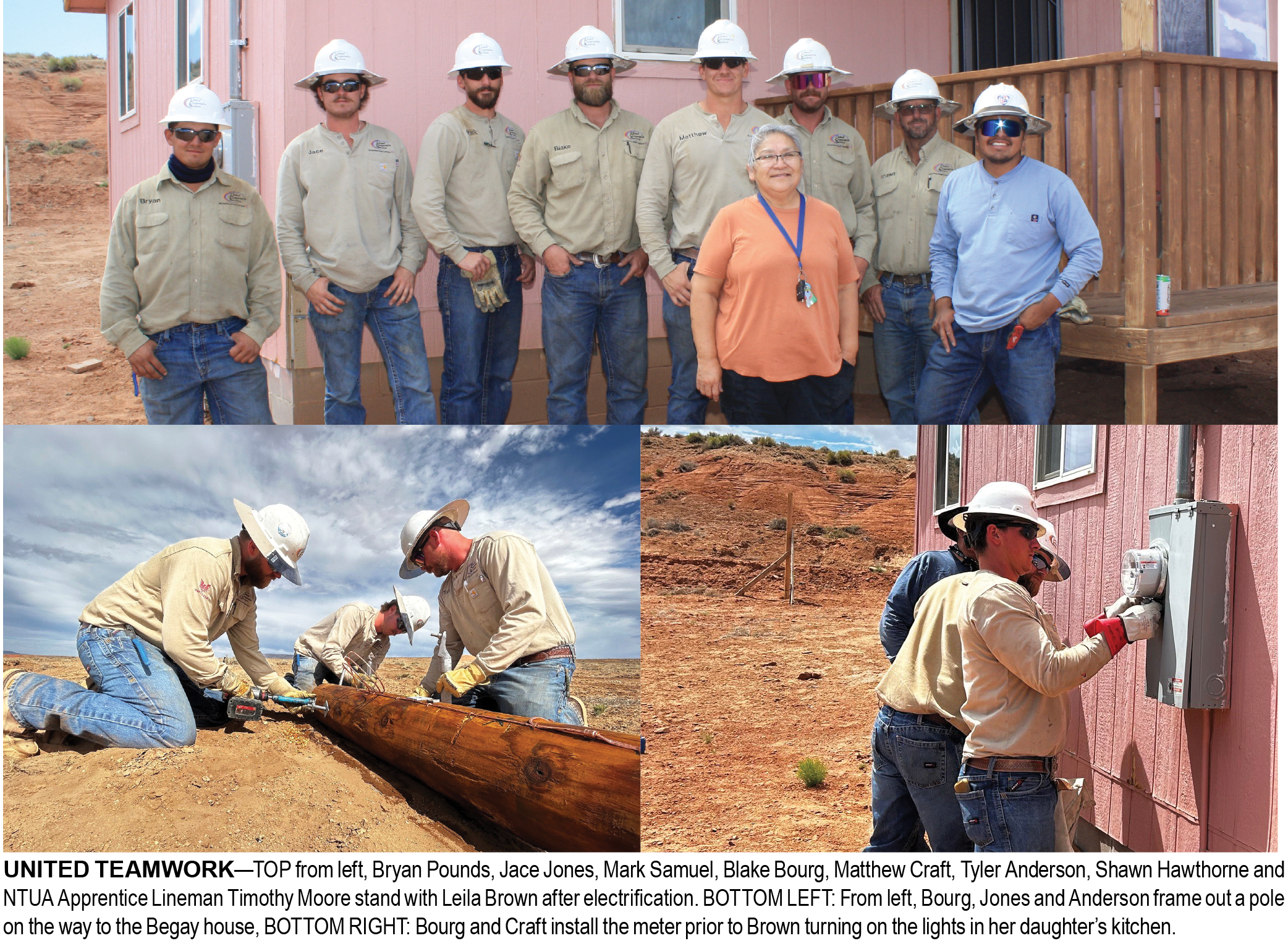
Leila Brown rushed over to her daughter’s house, watching and waiting as linemen from United Cooperative Services at the Navajo Tribal Utility Authority (NTUA) completed the connection and placed the meter into the box. Her daughter couldn’t be there, she said, so the honor of flipping the switches instead fell to her.
With a soft click, Brown gasped and shouted, “Oh my gosh!” as the kitchen flooded with light. The 67-year-old smiled as she tried other switches. Bulbs illuminated. Fans whirred.
The daughter of a shepherd, she had grown up with her mother and brother in the modest house next door, she said, and knew what it was like to live without. On this warm Arizona day, electricity finally arrived.
“Oh my gosh, it’s exciting,” she said smiling before her eyes welled with tears. “I don’t want to cry. It’s nice, you know, to see the lights on. Yesterday, I was driving up, and I saw all the poles on the way up. I got emotional. Finally, we’re getting electricity here.”
This June, seven members of United Cooperative Services’ line crew traveled to Chinle, Ariz., to participate in the Light Up Navajo project. The mutual aid and training initiative is a program of the NTUA in coordination with the American Public Power Association. The program extends powerlines and provides electric service to rural Navajo households that lack power.
The United crew worked tirelessly for two 14-hour days standing up more than a mile and a half of wire all the way to the pink two-bedroom house where Brown and her daughter, Melanie Begay, live. The crew said powering the house served as a perfect crowning achievement, ending a long week of hard work before they returned home to Texas.
Blake Bourg, Cleburne line crew chief, said electrifying Begay’s house was rewarding and reminded him of how his co-op forebears did the same kind of work in United’s service territory through the Rural Electrification Act of the 1930s.
“I didn’t know there were people who still didn’t have electricity in America,” Bourg said. “When I found that out, I immediately decided I wanted to do this. It’s kind of crazy. You almost feel like what they felt back in the 1930s when we started building power to people out in the farming areas who didn’t have electricity. We’re kind of doing the same thing. When you see that lady start crying when she flips the light switch on, it just makes it all worth it.”
Along with Bourg, United’s crew members included Mansfield District Foreman Mark Samuel; Burleson Line Crew Chief Tyler Anderson; Granbury Line Crew Chief Shawn Hawthorne; Bryan Pounds, a first-class lineman from Stephenville; Jace Jones, a first-class lineman from Cleburne; and Matthew Craft, an apprentice lineman II from Meridian.

Experience of a Lifetime
United CEO Cameron Smallwood said the co-op wanted to be a part of the project after hearing about it from other co-ops who had joined the effort.
“United has participated before with the NRECA International program to assist in energizing people for the first time in other parts of the world,” he said. “After hearing about Light Up Navajo, we decided this project aligned with our mission to energize other people who lack electricity, and it gave us a way to do the same type of work domestically. Honestly, I couldn’t be more proud of our crew and how their work has positively impacted members of the Navajo Nation.”
The opportunity to make the kind of impact Light Up Navajo offers doesn’t present itself often, and when Mark Samuel heard about the chance to bring power to people who may never have had electricity, he said he jumped at the chance to volunteer.
“It’s an experience that not a lot of people get to do,” Samuel said. “So, I was really excited to have an opportunity to turn on power for people who haven’t had it at their homeplace. NTUA is doing a good thing. The program that they’re putting together is very unique, and it gives the guys who participate a lot of good experience.”
After two days of driving and a day of orientation, the crew were guided to job sites by two NTUA employees from the Chinle District during a four-day span. In that time, they managed to set 35 primary poles, six service poles, set 10 anchors, hang two miles of line and energize four homes.
Burleson Line Crew Chief Tyler Anderson said he was amazed by the beauty of the landscape as well as surprised by the remoteness of several of the locations the United crew visited.
“You’re kind of out there in uncharted territory,” he said. “You hear stories from back in the old days where some old man will tell you, ‘We built a mile of line in a day, easy.’ Well, we don’t get a lot of opportunities to build a mile of line nowadays, but we dang sure did when we were down there. So, you get in the groove of going and figure out what’s quicker. It’s always safe, but you learn to be more efficient.”
Along with the strong camaraderie the crew built as they worked, Anderson said his favorite part was setting the meters and watching people’s reaction as they went inside to test their electricity.
“It’s really cool to be able to see their house have power for the first time just knowing that we did that,” he said. “We sweated on that line, we built it, we framed the poles all the way up to the meter set. It was a really neat thing to watch. I would totally do it again.”
Veteran NTUA Lineman Benny Begay oversaw the United crew. Since the program’s inception, he said he has watched firsthand the difference Light Up Navajo volunteers make by helping to electrify homes more quickly, improving living standards and creating opportunities that improve the community for generations to come.
Throughout the week’s interactions, Begay said he was happy with the help that United provided and hoped they come back to participate again.
“The United crew, I rate them 10 out of 10,” he said. “They’re very helpful and they know what they’re doing. You don’t have to watch them. They’re very quick and very helpful. They’re good guys. I tried to get them to stay another two weeks, but maybe next year. I’m very thankful that United Cooperative Services is here helping our people.”
About Light Up Navajo
At more than 27,400 square miles, the Navajo Nation is the largest Native American reservation in the United States where more than 298,000 members live. About the size of West Virginia, it spreads across Northwestern New Mexico, Northeastern Arizona and into Southeastern Utah.
NTUA was created in January 1959 by the Navajo Tribal Council. Today, the nonprofit enterprise provides electricity, water, wastewater, natural gas, solar energy and communications services, according to Gary Monroe, the Chinle District manager for the utility provider.
Getting electricity and other utilities to tribal members in the vast, rural landscape poses many challenges, he said.
“We have people who live way, way in the back of each community,” he said. “There are still a lot of dirt roads, and it’s really difficult to get to some of those people. We try to provide to as many of our people as we can, but we can only get to so many.”
Janice Harvey is the project supervisor for NTUA’s Chinle District. She said participation in Light Up Navajo from crews coming from all parts of the country has helped accelerate NTUA’s ability to connect more people to electric service in deeply rural areas.
Prior to Light Up Navajo, the Chinle district’s monthly average was fewer than 20 electric service projects. Now, that number has jumped to 150 projects a month on top of regular new requests for service.
“The initiative started in 2019 when our general manager identified over 15,000 families without utilities and electric,” Harvey said. “Since that time, the number has decreased significantly. We’re in the 8,000s, but that’s still a big number of families that are without electricity.”
More utility connections and customers are great, Monroe said, but human impact is much greater. He regularly hears the transformative power of electricity as families impacted by Light Up Navajo come into the appreciation dinners.
“Just last week during our appreciation dinner, we had a family come in,” he said. “They were saying they had to do their homework to lanterns. They said it was really difficult. They were very appreciative to have electricity now for their kids. To hear that and see that, it makes you get up every morning to come to work. That is one of the big reasons why we do it. It brings happiness to you.”
The evening Melanie Begay’s meter was energized, NTUA hosted their weekly appreciation dinner for the United and Georgia crews. She was one of more than 10 people who stood up to speak that night to thank the crews for their hard work.
Melanie sat at a table near the United crew along with her mother, Leila and her grandmother, Addie Begay. Though she said she was nervous about talking, she said she wanted to express her deep gratitude to the crew and share what a special day it was for her and her family.
“My grandma is 94 years old,” she said. “Her husband passed away one year ago today. When I asked them if I could put my house there, my grandpa was the one who was really for it. It rained today, and it hasn’t rained here for a very long time. I always say rain is a blessing for us. I feel like my grandpa was with us today and this week. He would have loved to see the electricity. I’m just glad that my grandma is here to see the electricity is up and she can finally move home. I just want to thank the crews from Texas and Georgia for coming out and volunteering your time. I hope this volunteering that you guys have done comes back 10-fold with blessings.”